Nobody really knows what Web 2.0 will do to the software industry.
That's my quick summary of the Software 2006 conference, which I attended yesterday and today. That's not a mobile show, and so this isn't going to be a post on mobile technology. As part of my work with Rubicon Consulting, I'm trying to get back in touch with the tech world beyond the mobile space, and this was a step in the process. I wanted to share what I learned.
I haven't been to this conference before. Attendees are a mix of IT managers and software company executives. Despite the broad name, the focus is mostly on enterprise software and business services; the big enterprise players like Oracle and SAP had keynotes.
My one-line summary of the show was an oversimplification, of course. A more nuanced summary would be, "there are many conflicting and incomplete opinions on what Web 2.0 will do to the software industry." To be even more detailed, there isn't even a single agreed term for what's happening, let alone agreement on which aspect of it is most important. Some people here talked about Web 2.0. Some focused on "Software as a Service," which is typically shortened to the irritating acronym "SaaS." Some focused on outsourcing, some on globalization (which is subtly different from outsourcing). And since this was a software conference, a couple of people talked about open source.
The one thing everyone seemed to agree on is that when you add together these trends, all of which are happening at the same time, the software industry will change fundamentally. But there's no consensus on what it's changing into, or what to do about it. Here are some of the ideas I heard, with my comments:
Selling to consumers at work
Ray Lane, formerly of Oracle and now a general partner at the VC firm Kleiner Perkins, talked about the attributes of the most promising new software companies. Like many VC presentations, the heart of his talk was a list of checkoff items a VC looks for when browsing a business plan. His hot buttons include software that's viral (anyone can download it and try it out), that generates value for an end user (so they'll have an incentive to install it), that doesn't require any data entry or training (so users can work with it instantly), and that generates instantaneous value (he called it "value first, pay later").
To me that sounds a lot like consumer software, which is a little strange for an enterprise conference. And in fact when Lane listed some of the most important of these new enterprise apps he listed several tools that I think of as consumer – Skype, instant messaging, and Google Desktop. Plus of course Salesforce.com ("SFDC" among the acronym crowd).
This idea of a blurring between the consumer and enterprise worlds wasn't discussed heavily in any of the presentations, but it lurked in the background all over the place. The selling and marketing model changes profoundly if you're trying to get an online service deployed virally in companies via end users, as opposed to selling down through IT managers. Most of today's enterprise software companies don't have a clue how to sell this way, and it makes them extremely uncomfortable. This is an area where I think Microsoft has an advantage over an Oracle or SAP, because it has a strong consumer business. We'll have to see if it can deploy that skill set to its advantage.
Another issue Lane mentioned, and one that I think is incredibly important, is the cost variation between online services and traditional enterprise software. He talked about "services that cost $50 per user" displacing $500,000 enterprise software sales. That's a life-threatening problem for every big software company from Oracle to Microsoft, and no one I heard at the conference had a compelling answer to what they should do about it. Usually they just say, "it's a big challenge..." and then the room goes quiet until someone changes the subject.
Software as a Service: tool or business model?
There were two panels on Software as a Service, and they had very different perspectives. The usual pitch for Software as a Service emphasizes flexibility and fast turns – your software gets updated rapidly at low cost, enabling a vendor to underprice the incumbents. But that wasn't the perspective at the first panel, where the focus was on vertical solutions.
The panel included representatives from Sonata, IBM, Embarcadero Systems, and Yodlee. Embarcadero creates management software for seaports, and Yodlee does web back-end software for banks (they power the consumer financial transaction websites for many banks).
Embarcadero and Yodlee are both Software as a Service companies, but they use the flexibility of web software to create intensely customized software programs tailored to narrow verticals. The whole idea of viral adoption and quick turns is foreign to them – no end user installs software to run a seaport, and quick feature changes are disruptive to banks because their marketing departments can't communicate the new features quickly enough.
IBM reveled in this pitch because they say these vertical customers need to be reassured that they can rely on this hosted vertical software. IBM positions itself as a business partner to these vertical companies, providing services and an aura of reliability.
Yodlee gave an interesting example of the things they have to do to build trust. The banks want guaranteed response time for a financial transaction, which is very difficult to do when your product is a web application running on the public Internet. So Yodlee invests heavily in monitoring the performance of its customers' web servers. This is something it does surreptitiously, so it can route around problems and also so it can document the cause if there are any complaints about its service.
At first it was a little weird to think of Software as a Service companies that focus on slow turns and heavy infrastructure investment, but to me it made an important point. Software as a Service is a design approach, not a product. It can be adapted to solve a lot of different problems in different ways.
The true believers speak up
The second panel was much more what I expected. Panelists included Liz Herbert, an analyst from Forrester; Treb Ryan of OpSource (which makes tools for Software as a Service companies), Steve Lucas of Business Objects (which is adding a hosted service to its traditional software offerings), Gordon Ritter of Emergence Capital (a VC which focuses exclusively on Software as a Service), and Sam Ramji of Microsoft.
Overall, the Software as a Service guys were passionate and evangelical, just what you'd expect from people who have a shiny new paradigm that answers every question. Business Objects was cautions, and Microsoft was surprisingly quiet. The panel reminded me a little of a 1960s encounter between a flower child and Jack Webb of Dragnet. The hippie is saying, "you just don't get it, man, the machine is going down," while Jack Webb's rolling his eyes and trying to get the license number of the VW microbus that ran over the poodle.
Some interesting points:
--It's not just about hosting an existing app on the Internet. You have to design it from the ground up as a service.
--The challenge is, "how quickly can you iterate?" Get a product out there that does something useful for someone, then add features over time. Say "no" to any feature requests that get in the way of doing this first basic launch.
--A great opportunity for Software as a Service is "critical but noncore" business services. A core service would be selling logistics software to FedEx. You don't want to do that because logistics are so critical to FedEx that it's going to buy an app that it can install and customize onsite. But you could sell an online HR services product to FedEx, because that's not their core business. What's core and noncore varies by company.
--Ritter was very skeptical about companies that try to offer both online services and a version of their software that a customer can host on his or her own servers behind the corporate firewall. The concern is that once you let a customer host the app, you'll be tied into maintaining it, and you lose the agility that makes a Software as a Service company successful. He quoted a financial analyst who said, "if a (Software as a Service) company offers just one customer a behind the firewall solution, I'll cut their projected market capitalization in half."
--Ryan on Software as a Service companies that offer radically lower price structures compared to traditional software companies: "They're exposing how little value you got for the software in the past....They're rationalizing the value, not cutting the value."
--Lucas on the difficulty of harmonizing price between a traditional software product sold to a large enterprise, and a Software as a Service product sold to a small company: "I just charged Coca-Cola $15 million, and now you're beating me up over $29? Goodbye, gotta' go."
--Web 3.0 is what happens when the VARs and other parts of the software delivery chain also deliver their added value as an online service.
--Herbert from Forrester shared some interesting survey data showing that among enterprises, 26% are using Software as a Service, 4% plan to use it, 8% are very interested but have no plans, 21% are somewhat interested, and 41% are not interested at all. Those figures reminded me of what PalmSource found when it tried to measure corporate adoption of mobile data – about a third of companies were early adopters who sprinted ahead with major deployments to their employees, and the other 2/3 were cautious adopters who were barely even doing trial deployments.
Blogging as a business tool
The diversity of companies' attitudes toward blogging is fascinating. The range goes from companies like Sun and Microsoft which have aggressively embraced and implemented blogging, to firms that are still trying to decide whether they should have anything to do with it. I sat through a panel on the subject that featured two journalists (Sarah Lacey of BusinessWeek and Fred Vogelstein of Fortune), Bruce Lowry of Novell, and Andy Lark from Sun.
Some highlights:
--The journalists spent a lot of time talking about blogging's impact on print publications (doesn't kill the best ones, but it's cannibalizing advertising revenue, and a reader on the web yields only about 20%-30% of the advertising revenue that you get per reader of a print publication).
--Lacey and especially Vogelstein were skeptical that most companies will ever adopt blogging as aggressively as some tech companies have. As Vogelstein put it, "will blogging in companies run into a roomful of lawyers?"
--Blogging makes it so easy to post information that it's much harder for readers to determine what's true and what isn't. This will help to maintain publications like the Wall Street Journal and the New York Times, because they're trusted to do fact-checking.
--Lark said he now spends more time using blogging software than Microsoft Word. Some Sun blogs get more than 50,000 visitors a day. Blogs also profoundly affect the search traffic coming to a website, and so can change the economics of marketing for a small company.
--Blogs can be especially useful for small companies that can't get any attention from the mainstream tech media. A blogging effort lets them communicate directly to interested customers with no intermediary.
At the end of the session, I tried to ask a question about the sort of people you can communicate with via a blog. In my experience, weblog readers (like you) are generally much more technically sophisticated than the average person. Most of them are influencers and early adopters – the sort of people who generate word of mouth for a product, but not necessarily an average customer. There seemed to be some agreement from the panel, but I wasn't sure Lark and Lowry really bought into it. Lark said Slashdot is great because he can use it to collect knockoffs on competitive products – he just writes down what people said on Slashdot. I think that works a lot better when you're selling to technophiles than when you're selling to average consumers. But then Sun's not a consumer company, so maybe their customers are all Slashdot readers.
Microsoft's plan for everything
Outlook as the user interface and platform for web services. That's the strategy. Got it?
Simon Witts, senior VP of the enterprise and partner group at Microsoft, said browser-based interfaces to web services are hard to learn and use. People already know how to use Outlook, so it makes sense for web services to integrate with Outlook, inserting documents into the user's message queue. He said Microsoft has exposed APIs to Outlook that let companies develop these services, and claimed that that firms like SAP and Oracle are very enthusiastic about doing it.
In addition to giving an arguably better user interface, this use of Outlook could enable a web service to work both offline and online, leveraging Outlook's architecture for caching and syncing transactions. To me, this is the most powerful part of Microsoft's pitch, since there's no industry standard infrastructure I'm aware of for for melding online and offline transactions.
Witts said Microsoft plans to extend Outlook to cover other business processes, including mobility, collaboration, search, workflow, customer management, infrastructure, unified communication, content management, business process integration, and business intelligence.
I wasn't clear on whether Microsoft intended to implement all of these itself or to work with partners; maybe a little of both. Certainly if Microsoft succeeds in making Outlook the interface to everything it will put competitors at a disadvantage. For example, if Outlook is the default interface to use search, that turns Google back into a plumbing provider the way it was when it powered Yahoo search. Microsoft's approach would also make obligatory the installation of Microsoft software on every device that interacts with the web – PCs, laptops, and mobile devices.
It's a very sweeping vision, but I'm not sure if it's Microsoft's vision or just the Outlook team's vision. Whichever is the case, web services companies should be very careful about putting themselves under Microsoft's control.
Mobile was an afterthought
Mobile was mentioned in a number of presentations, usually in a list of important new trends for enterprise software. But no one I saw discussed it in any depth. I think most of the companies are more concerned about what's happening on the web, and they also seem to think they can handle mobile via a straightforward browser client. Not true, because of latency and coverage limitations, but they won't figure that out until they get into it and a few products fall flat.
India, India, India
One of the most interesting sessions, even though it had very little to do with the rest of the conference, was a panel on bringing technological innovation to the developing world. Participants included Adam Lashinsky of Fortune, John Wood of Room to Read (which is trying to install libraries in the developing world), Jim Koch of Santa Clara University, David Green of Project Impact (which focuses on health care for the developing world), and CK Prahalad of the University of Michigan.
Prahalad is mot famous as co-author of Competing for the Future, the book that inflicted the concept of core competency on the business world. It became one of the most overused business cliches of the late 1990s, and gave large consultancies the opportunity to bill companies millions of dollars for basically telling them to focus on tasks that they were good at.
I' a lot more comfortable with the ideas that Dr. Prahalad is pushing now. In the panel and a separate keynote, he lectured the audience passionately on what's happening in the developing world and what to do about it. He said his goal is to make capitalism humane, so everyone can benefit from it, and therefore so the world stays stable. I expected the audience to tune this out, since it was so far away from the vendor presentations in the rest of the conference. But a lot of people seemed to eat it up. Some tidbits from Prahalad and the other panelists:
--Companies need to design solutions to scale radically for the number of people in the developing world. "If you can't touch 100 million people, it's not going to solve the problem."
--Change the way you think about pricing. Rather than starting with what it costs to make something today, and then adding your profit on top of that, find out what people are able to pay and then figure out how to sell profitably at that price point. This means learning how to build cars that sell for $4,000, or performing cataract surgery for $30. Throw out and restructure everything to make this sort of price points work.
--Forget about the four P's when selling to the developed world. Instead, focus on the four A's: awareness, access (distribution that reaches people in the developing world), availability (products in a form that the target customers can use), and affordability.
--Wood described his effort to get 20,000 libraries built in the developing world, and to get books for those libraries written in local languages. For example, he talked about getting children's books written in Tibetan. Someone in the audience asked about the effort to create a $100 notebook computer; wouldn't it be better to distribute a lot of these rather than building libraries for paper books? I thought Wood would be welcoming to this, but actually he was quite dismissive. "We're kidding ourselves if we think there are a lot of high tech solutions that are going to work in the jungles of Vietnam." Rather than delivering a PC for $100, he wants to deliver a library at a total cost of $5 per child, or a school that will serve 500 kids for $10,000.
Prahalad chimed in: "A lot of the thinking is very elitist...poor people have their own priorities. If you don't include them...it isn't going to work." Solutions must be adapted to local needs – what works for a village in Cambodia won't work for a village in India. Concentrate on setting global standards and then customize.
He said western businesses must approach the developing world with dignity and humility, and co-create solutions with them.
Point well taken.
Wednesday, 5 April 2006

Saturday, 1 April 2006
Implications of the Google-Sprint merger
Like just about everyone else in the tech industry, I was caught off guard by Google's announcement late yesterday that it's acquiring Sprint. We all knew Google was interested in the wireless market, but I don't think anyone expected it to make a move this big, this quickly.
In retrospect, though, I think the deal was kind of obvious.
Google can compete with the wireline phone companies and the cable TV companies by offering municipal WiFi networks. It didn't have to acquire companies in those spaces. But WiFi mobile phones aren't ready for prime time – there are too many holes in the network coverage. Google needed a play in the mobile operator space. By combining its WiFi offerings with Sprint's mobile network, Google will be able to offer comprehensive communication and data services that can't be matched by any other company.
The press release was pretty sparse on details, but I loved the statement that we'll be able to use a single Google ID to receive phone calls, e-mail, and instant messages anywhere in the country. I like its commitment to offer unlimited flat-rate voice and data. And I was thrilled by Eric Schmidt's promise that Google's mobile data network will be open to any application from any vendor.
It'll be very interesting to see how the competitors react. Is Yahoo going to buy Cingular? I have to assume that Microsoft will feel obligated to buy an operator as well, but without the other Web properties that Google owns, Microsoft will find it very hard to match Google's scope and synergies.
I also start to believe the rumors about AT&T buying Comcast. They'll need it to compete with Google across the board.
It will also be interesting to see what happens to the handset companies. I don't believe Google or Yahoo will be willing to accept mobile phones whose user interfaces are as cluttered and confusing as the ones on the market today. Well, maybe Yahoo would.
The biggest downside of the Google-Sprint deal is that today is April Fool's Day, and I fabricated the whole thing. None of it's true.
Not yet anyway.
Friday, 31 March 2006
The Zen of Product Management
Product management is becoming a hot topic in Silicon Valley. The UC Berkeley business school had me speak at a seminar on the subject last week, a lot of consultants are focusing on it, and it seems to be getting a lot more buzz than I remember seeing in the past.
A product manager is the person in a company who translates customer needs into product features. He or she is not necessarily an engineer, but tells the engineers what to build (assuming you work in a company where the engineers do what anyone else tells them to do). When product management works well, a company has a much better chance of producing a successful product.
Recently I ran across an almost year-old summary of a presentation given by Rob Haitani of Palm. He's the author of the original Zen of Palm, the presentation that codified Palm's early design philosophy. The Zen of Palm is widely misunderstood as a kind of dogmatic belief that handheld computers should have only a few simplistic features (which is about as accurate as saying that basketball is a game in which people throw a ball). Actually it was a pretty subtle strategy, and the presentation was a fantastic tool for indoctrinating new hires.
Although Haitani's title at Palm isn't product manager, that's what he does. The article gives a nice overview of some of his ideas. I think it's a good reference for product managers in any industry.
Thursday, 30 March 2006
A fun read
I've had Telepocalypse in my blogroll for a while, but I never explained why. Marvin Geddes is a telecom consultant living in Scotland. He's interesting and acerbic and he has the deep pool of skepticism that seems to develop in many people who work closely with wireless operators in the US and Europe.
He also writes extremely well, which makes his weblog a nice mix of information and entertainment. For example, here's his description of the psychology of an operator offering data services:
"Owning a communications network is rather like being the in posession of Tolkien’s Ring. It slowly corrupts and drives mad the keeper. 'I’ll capture your value, all my beautiful bits, preciousssss bits'."
And then there's a little gem that I won't even try to describe. You just have to read it for yourself. Maybe you have to be a parent to fully appreciate it, but it still makes me laugh every time I read it.
Going to CTIA
I'll be at the CTIA conference in Las Vegas next week. Please drop me a note if you'll be there and would like to talk. When I get back I'll blog on anything interesting that I saw.
Monday, 20 March 2006
News flash: KPMG discovers world is round
Forgive me for the cynical headline -- I actually think we should view this as progress. The accounting and consulting firm KPMG just announced it has discovered that most mobile phone customers aren't willing to pay anything extra for new features or services on their phones. In particular, only about 30% of users were willing to pay more than a 10% surcharge. The figures came from a survey of about 3,500 mobile phone users around the world.
How much mobile phone users are willing to pay for enhanced services:
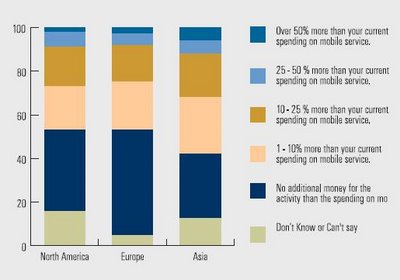
What's more, KPMG discovered that the mobile users who are willing to pay more fall into different usage segments: "Operators need to stride further by segmenting the market, potentially between 'entertainment users' and 'information users.'"
This isn't news to anyone who has been paying close attention to mobile users. Forrester wrote about it in 2002, Jupiter Research wrote about it in 2003, and we found the same thing in our research at PalmSource.
Unfortunately, it doesn't seem like the message has been getting across, because folks like Reuters and the Financial Times are treating the report as important news. That's okay with me -- the more repetition the story gets, the better the chance that it'll finally sink in.
The other notable part of the report was its commentary on business models. The report noted that since different people want different things, operators can't put themselves in the business of dictating what features customers will want:
"Beware of the 'killer app' trap....The opportunity to serve media-hungry consumers is there for the taking, but...those carriers that try to 'wall in' the types of services they offer - or hang their hopes on one particular application or service - are likely to fail to meet customer expectations....Carriers will not be able to meet customer needs alone - thus the importance of sharing their customers' wallets with other partners."
In other words, the right business model is the one employed by NTT DoCoMo in iMode – open your network to independent developers, let them offer whatever apps and services they want, and take a cut of the developers' billings. Seems obvious, but most operators are still trying to do all the thinking for their customers.
Even though the findings of the survey aren't revolutionary, I think the whitepaper is a worthwhile read. It summarizes the key issues better than just about any single document I've seen.
How much mobile phone users are willing to pay for enhanced services:

What's more, KPMG discovered that the mobile users who are willing to pay more fall into different usage segments: "Operators need to stride further by segmenting the market, potentially between 'entertainment users' and 'information users.'"
This isn't news to anyone who has been paying close attention to mobile users. Forrester wrote about it in 2002, Jupiter Research wrote about it in 2003, and we found the same thing in our research at PalmSource.
Unfortunately, it doesn't seem like the message has been getting across, because folks like Reuters and the Financial Times are treating the report as important news. That's okay with me -- the more repetition the story gets, the better the chance that it'll finally sink in.
The other notable part of the report was its commentary on business models. The report noted that since different people want different things, operators can't put themselves in the business of dictating what features customers will want:
"Beware of the 'killer app' trap....The opportunity to serve media-hungry consumers is there for the taking, but...those carriers that try to 'wall in' the types of services they offer - or hang their hopes on one particular application or service - are likely to fail to meet customer expectations....Carriers will not be able to meet customer needs alone - thus the importance of sharing their customers' wallets with other partners."
In other words, the right business model is the one employed by NTT DoCoMo in iMode – open your network to independent developers, let them offer whatever apps and services they want, and take a cut of the developers' billings. Seems obvious, but most operators are still trying to do all the thinking for their customers.
Even though the findings of the survey aren't revolutionary, I think the whitepaper is a worthwhile read. It summarizes the key issues better than just about any single document I've seen.
Sunday, 19 March 2006
What's going on in Japan?
I have to admit that I'm a bit of a Japan-o-phile. My relationship with the place started when I was a competitive analyst at Apple, which paid me to fly over there and wander the Akihabara electronics district buying interesting products (you never appreciate the really good jobs until you're reminiscing about them).
If you've never been to Akihabara, it's an area of maybe six or seven square blocks packed with electronics department stores, many of them six or eight stories tall. There's also a warren of tiny shopfront cubicles selling individual components – capacitors in one, switches in another, ICs in a third.
It all makes Fry's Electronics, the geek electronics mecca of Silicon Valley, look like a lemonade stand.
The great thing about Akihabara is the intense variety of electronic stuff. I remember standing in awe before a wall with more than a hundred shavers, each with a slightly different mix of features. And the mobile phones! Shapes and colors and especially features years before they appear anywhere else.
Now Apple's long behind me and nobody's paying me to go play in Japan anymore, which is frustrating because I'm losing touch with the trends. The tech press and analysts aren't much help because they mostly ignore Japan. But I've found two websites that help.
The first site is Wireless Watch Japan. I've spent a long time looking for the ultimate English-language site for mobile news from Japan, and I haven't found it yet (post a comment if you have advice). But Wireless Watch is pretty good – it posts a lot of news, which is all consolidated to the RSS feed (the feed seems to have more articles than the homepage). The downside is that it truncates its articles and you have to pay $200 a year to get the full text. Still, it's a good place to follow sagas like Vodafone's sad exit from Japan after it bought and then screwed up the former J-Phone. Plus the website carries a running tally of the subscribers to each of the Japanese operators (just over half of Japanese mobile users are now on 3G, by the way).
The second site is What Japan Thinks. This is a collection of translated market research studies, exploring strange and interesting aspects of Japanese culture. Many of the studies are tech-related, which makes the website a mix of useful and truly bizarre information. Recent tidbits: 25% of Japanese people surveyed said they use their mobile phones more than three hours a day, only 1.4% of Japanese coffee shop users go there to use a personal computer, and the three most popular cuts of grilled meat in Japan are beef ribs, chicken thighs, and tongue. Who knew?
The methodology of the studies varies from strong to completely invalid (for instance, the one on phone usage was apparently self-selected, which biases a study strongly toward enthusiasts). So you need to read the details of each report very carefully. But the information's often thought-provoking, and I can't find anything else like it in English.
I'd love to find similar sites for other Asian countries. If you know of any, or if you have other suggestions for Japan, please post a comment. In the meantime, although the ones I've listed here are not as good as a trip to Akihabara, at least you don't have to spend ten hours crammed into JAL coach to get there.
Subscribe to:
Posts (Atom)