I want to tell you a little story about a mobile data application. From one perspective you might think it's trivial, but to me it speaks volumes about how the mobile data market works and what suppliers need to do to make it successful. I have to give you some background in order to explain the story; please stick with me and you'll see where I'm going.
I'd been hoping to post a big commentary on the future of mobile platforms this week, but I couldn't get it done. My schedule slipped because I was heavily involved in a neighborhood protest against a nearby housing development. A developer was looking to build houses that are about twice the size of anything else in the neighborhood, on much smaller lots. We thought it was a clear violation of the city's planning rules, and we were worried about what the close-packed houses would do to the neighborhood.
For months our protest had been working its way through the byzantine planning system in San Jose – several rounds of formal protest documents, meetings with city officials and the developer, flyers to the neighborhood, signs, a hearing before the Planning Commission, and finally a presentation Tuesday night before the City Council. We prepared a very extensive PowerPoint deck documenting the reasons for our protest, which is what used up my blog-writing time last week.
My neighbors asked me to be the lead speaker, meaning I'd have five minutes to summarize our case – and not a second more. San Jose City Council meetings start at seven pm and often run until one am or later, so the mayor enforces rigid limits on speaker time. It was critical that I make all our points, without skipping anything but also without rushing too much.
I scripted my talk and practiced it several times. Unfortunately, I couldn't get it consistently to come in at five minutes. If I accidentally added even one sentence, it caused the whole thing to go off course, and I'd run out of time before I hit the conclusion.
I was deeply worried. But then I remembered a survey we did a couple of years ago regarding applications usage on Palm devices. One of the most popular applications was something called Big Clock.
When I saw that at the time, I thought, "so what, a clock." But now I had an urgent need for something that would help me stay on track with the speech. So I searched for Big Clock online, and sure enough I found the website.
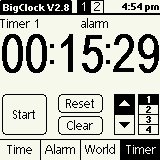 My Hero
If you haven't tried Big Clock, it is a combination clock, timer, and alarm system. And as the name implies, the numbers are extremely big. The timer function turned out to be exactly what I needed – I set it to five minutes, and it counted down the seconds in big numbers that I could read at a glance. As you can see, the interface is ugly but very functional, with large buttons that you can tap with a finger (something you need when you're on a podium).
Tuesday night at 11 pm, Big Clock and I made the presentation together. I was very grateful I had help, because sure enough my speech started to run long. When I noticed, I was able to talk faster and jump to the conclusion. I finished literally as the mayor started to tell me to shut up.
We won the case. I don't claim Big Clock did it all, but it sure helped.
Lessons about mobile data applications
There has to be a real need. I didn't care about Big Clock until I needed a timer, and then I needed it desperately. But if I did more public speaking, I probably would have sought it out a long time ago. Often mobile applications do things that are "useful" or "cool." Forget about it. If you aren't solving a burning need, the user won't go for it. (By the way, burning needs can include boredom – this is why mobile games sell well.)
It has to be easy to install. Palm OS isn't great at this, but fortunately Big Clock comes as a single file, so once I unzipped it on my PC I could just double-click on the icon and sync it to my device. It would have been even better if I could have installed it wirelessly.
It should be easy to learn. No, strike that – it needs to work with no learning at all. Big Clock shines here. The tabs are self-explanatory, and there are some delightful touches in the interface. For example, you can reset the numbers just by tapping on them – tap in the top of a number and it goes up one, tap on the bottom and it goes down one. I found this just by tapping on things – something the Palm user interface encourages (because you can rarely damage data or cause problems by tapping, you feel safe exploring).
The user must be aware of the application. I was lucky that I'd done that survey on application usage. Otherwise I probably would have never heard of the product, and you wouldn't be reading this today. I don't know how the average user is supposed to know what applications are out there.
Most mobile data platforms today fail one or more of these tests. Sometimes the application does something that looks cool but doesn't solve a real problem (I see this very often with applications developed by mobile operators). Or the applications are hidden, or they are hard to install, or the user doesn't even know they exist.
Failure on any one of these imperatives causes the whole mobile data ecosystem to fall apart. That's why most mobile data solutions fail today, and that's what I want to talk about fixing in my next post.
Next week, I promise.
Wow. Motorola, NEC, DoCoMo, Panasonic, Samsung, and Vodafone announced that they're banding together to create a unified Linux-based operating system for mobile devices. The group says it will create a unified set of APIs, but said nothing about user interface, so presumably they hope to differentiate from one-another at that level. The UI is pretty closely tied to the APIs, so I'm not sure how they will pull that off.
Anyway, this is potentially a major challenge to the Windows Mobile and Symbian worlds, as this new Linux would presumably be free of charge. I think it's also ominous for PalmSource/Access and TrollTech. It'll be much harder for any of the mobile OS companies to charge for their software if there's a practical free alternative. (Speculation: If Motorola had succeeded in buying PalmSource, would they be donating some or all of Palm OS for Linux to the new consortium? We'll never know.)
I think it's increasingly clear that OS plumbing is going to be a commodity in the mobile space; if you want to make money, you need to focus on the upper layers of the software.
On the other hand, the devil's in the details. As Symbian discovered, it is incredibly difficult to serve several different masters. DoCoMo can keep the Japanese vendors in line, but Motorola and Samsung are mortal enemies and I am very surprised to see them in the same camp. Maybe their mutual fear of Nokia and Microsoft trumped their dislike of one-another, but we'll see how long that lasts. Will the Linux partners band together to pull down the proprietary OS's, or will they use the knives on each other? Either way, the next couple of years should be a very entertaining.
The e-mail was from the CEO of a prominent mobile app developer, a company you've heard of if you're familiar with the mobile space. He makes software for a broad range of mobile devices – Palm OS, Windows Mobile, Symbian, etc. He told me that his overall application sales are disturbing:
"Companies like us (I've checked with a few others) have seen our market flatten or worse in 2005, especially in the 2nd half. While a simple example might be that this is due to new devices being late to the market...I keep wondering whether this might not be some deeper-rooted trend. I'd be delighted to hear about your view of our market (niche?) and its current dynamics."
Since then I've talked with a number of mobile developers, and heard eerily similar stories. Sales are stagnant to down, and the problem's not just focused on one OS. At one point I talked with the folks who run the Palm Entrepreneurs Forum to see if they'd be willing to let me survey their members, to confirm the problem. (PEF is an online forum for developers of software for all mobile devices, not just Palm OS. Their mailing list is highly recommended if you're running a small mobile software company. A lot of smart people hang out there, so I thought they'd be a good starting point.)
But the PEF folks told me, "Don't bother doing a survey. Everyone knows it's true." And sure enough, if you poke around on the web, you can find a lot of commentary raising questions about the viability of the mobile data market.
The situation was a big surprise to me. I knew from my time at PalmSource that many Palm OS developers weren't happy with their sales. No shock there. Palm OS hardware sales have been consolidating for a couple of years – Sony withdrew from the market, Handspring and Palm merged, Samsung hasn't done a new Palm OS phone in a long time, and several other Palm OS hardware vendors quietly withdrew from the market.
But I had thought it was just a Palm OS problem. Not so, the developers told me. They said application sales on Windows Mobile and Symbian are also stagnant, and although some developers report an increase in sales of RIM applications, the increase is on a very low base, and is not enough to offset the declines elsewhere.
It seems bizarre that this would be happening. The consensus among the industry analysts is that smartphone sales are rising sharply. Since the definition of a smartphone is that it can accept third-party applications, sales of those applications ought to be going up as well.
In some cases they may be doing so – the developers I talk to are not Java houses making simple add-ons like games and ringtones. There are anecdotal reports that sales of those are going pretty well. What I'm talking about is sales of more substantial applications, generally written to run native on the device's operating system. If the phone is becoming a multimedia computer, as some vendors claim, sales of these more sophisticated applications ought to be booming.
So why aren't they?
Before we can tackle that question, we need more data on device sales. Unfortunately, that's in very short supply. Three companies (Canalys, Gartner, and IDC) publish quarterly reports on shipments of handhelds and smartphones. Unfortunately, most of the information they collect is sent only to their paying customers, other than a teaser press release with a few statistics in it. Those press releases are not even issued every quarter, so there are gaps in the coverage. And the numbers themselves are not high-quality because they're just self-reported shipments into the channel. Vendors could lie, and even if they tell the truth all you know is what they shipped, not what the stores actually sold.
Nevertheless, these are the best numbers we have. By combining the Gartner, IDC, and Canalys numbers, and doing estimates to fill in a couple of gaps, I built the chart below. It shows estimated worldwide unit shipments of handhelds and smartphones, by quarter, for the last two years.
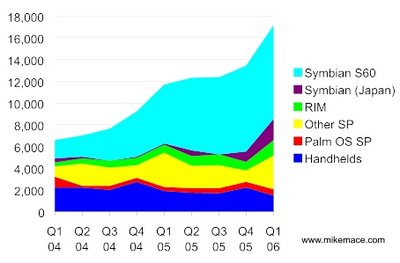 Quarterly worldwide unit shipments , in thousands.
This is one of those "stand back and squint" charts. Don't sweat the details of why a category went up five percent in one particular quarter – chances are that's a statistical anomaly. Look at the broad trends over the last two years.
A couple of notes on drawbacks of the chart:
--It's not possible to get an accurate estimate of quarterly Windows Mobile shipments, because the press releases don't report shipments by OS every quarter. They report by hardware vendor, and only the top five vendors are shown. The rest are lumped into "other." Most of Microsoft's licensees are smaller hardware companies that don't show up in the top five (even HP hasn't consistently been a top five vendor).
--I had to make some educated guesses about shipments of Symbian devices in Japan, because they sometimes make the top five and sometimes don't.
Despite these problems, it's possible to form some conclusions from the data:
--Total shipments of handhelds (Palm OS and Windows Mobile) are dropping steadily. Big duh, we all knew this.
--Total shipments of Palm Treo devices are growing, but not enough to offset the decline in handhelds.
--Total Palm OS + Windows Mobile + Other shipments have been declining on a year-over-year basis since Q2 of 2005.
--All of the year-over-year unit growth is in RIM and Symbian.
So it's not really accurate to say that the smartphone market is growing. The Symbian market is growing, the RIM market is growing, and everything else is flat to down.
What it means to third party application sales
I think there are three problems.
The first is that the two platforms that had been driving the most app sales, Palm OS and Windows Mobile, are not growing in total. The sales mix is shifting between them, but when you add everything up their overall sales are not increasing. That means we're selling more replacement units to the installed base rather than units to new users. Existing customers already have apps, so application sales drop.
The second problem is that as the mix of devices shifts from handhelds to smartphones, I think application downloads become less attractive. If you had a handheld, it was pretty clear that you could add more software to it, and since you synced it with a PC all the time it was fairly easy to get and install new applications. But a smartphone feels more complete – it has a lot more software bundled on it (in some cases more than you can use). Microsoft has also shifted much of its sales mix (we don't know how much) to devices that don't have touchscreens. On these devices it's harder to use some classes of mobile applications, and some Pocket PC apps simply won't run on smaller, non-touchscreen devices. Also, smartphone users are much less likely to sync to a PC than their handheld counterparts, and without regular syncing it's a lot more difficult to find and install apps.
The third problem is that application sales haven't tracked the growth of some of the smartphone platforms (in particular Nokia S60, which is producing most of the reported growth in smartphones). The CEO who wrote to me compared his sales of S60 apps to UIQ applications (UIQ is the user interface used on the SonyEricsson p900 series of smartphones):
"We have Symbian Series 60 and UIQ versions since 2004. Even though S60 outsells UIQ at least 10:1, our UIQ version out-sold S60 10:1 – 5:1, and that's pretty constant across the industry. Most S60 phones have not been marketed to end-users as smart-phones and therefore their clientele is not smartphone clientele."
When I was at PalmSource, we surveyed users of Nokia S60 devices, and most were unaware that there was even an OS in their phone, let alone that they could add applications to it. They just thought it was a multimedia phone. I know Nokia's trying to change that, and they've made some progress, but given what the starting point was I'm not too surprised when developers say they haven't seen heavy sales of native S60 apps.
(Note that I'm not trying to beat up on S60 in particular here; the developers I talk with are disappointed by every platform.)
If you add up everything that's happening, it's a lot easier to understand why many mobile app companies are depressed:
--Palm OS and Windows Mobile, taken as a whole, are not growing. That probably accounts for the decline in app sales on those platforms.
--Smartphones in general are less likely than handhelds to drive app sales. The more handhelds are cannibalized by smartphones, the tougher the application sales process becomes. This would worsen the effect of the flattening demand for Palm OS and Windows Mobile.
--The platform that is producing lots of smartphone growth isn't currently a big driver of sales of sophisticated apps.
What do we do about it?
The CEO who wrote to me put the question very well:
"Is the market shrinking? Is it saturated? If so – why? Are these devices really irrelevant to the "rest of the world"? Are they not as useful as we all thought they were 5 years ago? Or is it something else altogether? Strategically, I have to wonder whether this is a hiccup in the market, or is this what we're going to see moving forward."
I wish I could say it's just a hiccup, but the evidence points more toward a change in market structure plus saturation of the core market that had been buying Palm OS and Windows Mobile devices.
That doesn't mean we should all give up, but I think there will need to be some changes in the market before mobile app sales will really take off again. As a couple of mobile developers told me recently, "we need a new platform." I'll write about what I think that means, and the prospects for it, next week.
____________________
Many thanks to the folks at All About Symbian for including my post on Sprint's 3G smartphone in the latest Carnival of the Mobilists.
Several months ago Sprint contacted me with an offer to become a "Sprint Ambassador." They said they had noticed my blog, and wanted to send me a free 3G phone, with service, for six months. No obligations, no requirements, and no restrictions on what I can write about it. If I choose to, I can send them feedback on the phone via a web form. At the end of the six months the service will be terminated (unless I want to pay for it).
Being the basically greedy tech geek that I am, I took them up on the offer. Within a couple of weeks I got a shiny new Samsung A920 mobile phone, and a free-ride, all-expenses paid account on Sprint's EVDO high-speed network. That includes free downloads of any content, games, or other services I want. Sweet!
I'm not sure what Sprint was hoping to get from me -- nice word of mouth or user feedback. But for sure I've been a disappointment to them, as I haven't posted any feedback to their website, and I haven't written anything about the phone on my blog.
Until now.
I have so many things I want to say about the phone that it's hard to know where to start. I guess I should do a summary. Here goes:
The best thing about the phone: It's a great data pipe. I can cable it to my laptop and use it as a high-speed data link. It works quite well, and has coverage in every urban area I've been in. I never thought I'd say this, but I like it better than WiFi.
The worst thing about the phone: Everything else. And I mean everything. The interface is borderline unusable, many of the services are a joke, and I'd be demanding a refund if I had paid for it.
My advice to Sprint: Embrace your destiny as a big data pipe. You do that superbly, and I think people would pay you for it. Meanwhile, you should stop over-complicating your phones with data services that you're clearly not competent to create.
Here are the details:
The good stuff
I was at a dinner with Barak Berkowitz of SixApart a couple of weeks ago, and I talked about the prospects for WiFi networks spreading in urban areas. Barak challenged me on it. "EVDO rocks!" he said. Who needs WiFi?
I think he has a point, with a couple of caveats. Here in Silicon Valley, WiFi is both enticing and frustrating. I have yet to find anywhere in the entire urban area where there's not a WiFi hot spot. I go to my son's little league baseball game, out at the edge of the suburbs, and I can see eight different hotspots in the neighboring houses. But usually all of them are locked -- I can find the connections, but I can't get in. At this year's CTIA conference in Las Vegas, there was a very extensive WiFi network, but it was saturated or I wasn't accessing it correctly or something. I couldn't get in.
In both of these situations, I just popped out my EVDO phone, cabled it to the USB port of my computer, and I was on the Internet. I look like a geek, but I'm used to that, and the great feeling I get from having access anywhere is enough to compensate for any loss of social status.
I haven't done any formal benchmarks, but data transfer speeds seem about the same as my WiFi network at home. I have had occasional Outlook mail sync problems in which the program reported that it couldn't establish a secure connection, but other than that the connection has been very reliable.
There is no EVDO network outside the cities, of course. But there's rarely a WiFi connection there either.
Does EVDO kill WiFi? I'm not sure. The cool thing about the municipal WiFi networks is that many of them will apparently be free, supported by advertising. At worse, they'll probably be fairly low-cost flat rate. EVDO is more expensive, but it's easier to access once you pay the fee.
I don't know if I personally need connectivity around town badly enough that I'd pay for the service with my own money, but I'd definitely try to talk an employer into paying for it. They'd get enough added productivity from me that it would be worth the investment for them.
I'm going to miss EVDO when Sprint turns off the phone. If they fix the bugs in Outlook sync, I think they have a potential winner on their hands.
The bad stuff
I'm sorry to say that if it weren't for the EVDO-to-PC connection, I would be almost completely negative on my Sprint 3G experience. I've been struggling to decide what frustrates me more about the phone, the user interface or the services bundled on it. I've decided that it's the user interface, because some of the services are okay, whereas almost every aspect of the interface has problems.
Rather than trying to explain everything that's wrong, I'm just going to give you some representative examples:
Services
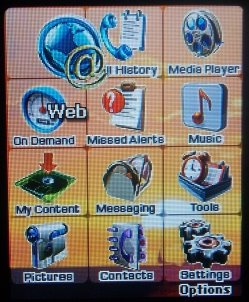 Web access that isn't. The phone has twelve icons in its first-level launcher. One is labeled "Web." It has a little picture of a globe and an @, just to make sure you get the point. I know from doing market research on mobile users that when you say "Web" they expect to get a full-function web browser. That isn't what Sprint gives me. There's no way for me to input a web address; all I have is a list of categories: Downloads, News, Weather, Sports, Entertainment, Money, etc. There's also a search function, but it searches only within Sprint's walled garden.
Within each category there are several choices that Sprint has pre-selected for me – in news there's CNN, USA Today, Reuters, etc. I can also get the NY Times, but that's $2.99 a month. I bought the Times (hey, Sprint's paying), and the phone downloaded a Java app that runs a special NY Times player. After all this hassle and $3 a month, the content looks almost identical to what I can get for free on CNN et al. I'm disappointed.
Just below the icon for Web is an icon called On Demand. I select it, and it gives me a series of options almost identical to what I had in Web – there's news, sports, weather, money, movies, maps, etc.
After a web search (on my computer, not the phone), I discover that On Demand is a Java-based content service provided by the nice people at Handmark. I should have realized this, because the app flashes the Handmark logo at me whenever it's downloading something.
Why does Sprint bundle a Handmark service that offers pretty much the same stuff as it bundles in Web? I have no earthly idea, but the clear implication is that Sprint threw things into this phone without any coordinated thinking about how it all fit together.
Slow, inaccurate, difficult to use mapping. Location-based services are hot, so I tried out the Maps function within On Demand. At its launch screen, I can either select the current location (via a check box) or enter an address. First I check the current location box. Sometimes the service fails to work at all, but on the most recent try (at a little league game) it cooked up a location that was about a mile northwest of where I actually was. I presume that's the nearest cell tower, but the app never warned me about this inaccuracy.
I tried to scroll the map over to my actual location, but every time I scrolled the map, the app had to call out to a server to retrieve the data. This took from five to 20 seconds per click, and reminded me of what it was like to browse the web on a 28.8 modem. This is one reason why I am not a fan of thin client apps on 3G networks.
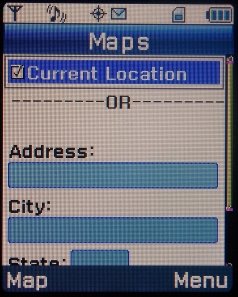
I decided I would try inputting an address instead, so I scrolled down to the address entry section of the main screen and tried to type. But the phone beeped at me and would not accept any input. It didn't explain what was wrong either; it looked like the app was frozen. After fumbling around for a while, I realized that I need to manually uncheck the Current Location check box before I can input an address. Hey, Handmark, why not uncheck the box automatically when I start to input an address?
The service seems to work okay at issuing driving directions, but because the phone can't tell where it really is, I have to input both the current address and destination, which is very tedious using a keypad. I could get a lot faster results just using a printed map.
Video: Paying for commercials. This is a multimedia phone (I know because it says "MULTIMEDIA" right on the bezel), so I had to try the video services. The first challenge is to find them. I try Web, which has an Entertainment choice within it. Sure enough, about five TV shows are listed. I pay $2.99 a month to get into Lost, assuming I'll get episode videos. But instead I get content like character summaries and 50-word episode recaps. What a colossal rip-off. I could get this stuff, in a lot more detail, for free on the Web; why am I paying for it here?
So Web clearly isn't the place to get video. There's an icon labeled Media Player, and an option within it says Channel Listing. I select that, and we're in business. A sub-menu lists Sprint TV Live, Sprint TV Ultimate, Music & Radio, Sports, Cartoons, News, and so on.
Sprint TV Live appears to be streaming of some basic cable channels, such as Fox News and Weather Channel. When I try it at the Little League game, the frame rate is noticeably low – maybe ten a second. And sometimes the audio gets choppy or pauses. I think what must be happening is that I'm at the edge of the EVDO network, so I'm not getting full throughput even though the phone reports four bars. (Keep in mind, though, that I'm at a junior high school within the city limits of the tenth largest city in the US, so I'd kind of expect good coverage.)
I tried the same streaming when I was downtown. There the sound was solid, and the frame rate was much better. So it's a network coverage problem.
Fox News and the Weather Channel get old after a while, so let's try a different option: Cartoons. Several channels are listed, including Cartoon Network Adult Swim. That's a late night cable channel that features obscure Japanese anime mixed with very strange original cartoons. Just the thing to amuse me when the little league game gets slow.
I pay my monthly fee for Adult Swim, and the program dumps me back into the top-level listing of channels. I expected it to launch Adult Swim, but instead I have to scroll back down to Cartoons, open that, and then launch Adult Swim. Bad interface design.
First nasty surprise: Not all the shows in Adult Swim are listed. There are only seven shows, and some of my favorites are missing. But okay, here's "Samurai Champloo," which is a very quirky and stylish Japanese samurai / hip-hop thing. So I select that one.
Second nasty surprise: After I select Samurai Champloo, I get a list of only two items – and they aren't episodes. They are just two-minute clips from episodes, each ending with a graphic telling me to watch Cartoon Network. That's right, I am paying these bastards $3.95 a month to watch commercials.
There's another channel dedicated just to anime. It costs $5 a month, and lists only five shows. Each has a single episode posted, cut into several five minute segments. At least I'm getting full episodes, but this is far from a generous selection when I'm paying $60 a year just for this channel!
I didn't try all the other channels, but it looks like you have to pay separately for most of them other than Sprint TV, and this video clip behavior seems to be the norm. Either I get little excerpts from episodes, or a couple of episodes are posted in full, but cut up into a series of clips.
Previously, I thought watching video on a notebook computer via WiFi and DSL was unpleasant – you had to wait a long time for downloads, and the pictures were small and grainy. But that seems like flying on the Concorde in comparison to the Sprint experience.
Disappearing music. I had my daughter try out the phone, and she naturally downloaded some songs. That was dodgy at my house (which, like the ball field, is on the edge of network coverage). She ended up standing in the living room, holding the phone up next to a window to make the download happen (coverage is better at the front of the house). Eventually we got several songs onto the system. The difficult trick was finding the songs again once we had downloaded them. I looked in the My Content icon, where downloaded games and ringtones were saved. But no songs. I tried Media Player, which has a function called "My Play List." The songs ought to be there, right? Nope, the play list is empty.
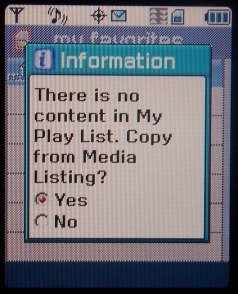 No, my songs aren't in the Play List. Maybe if I tell it to copy from the Media Listing (whatever that is)...
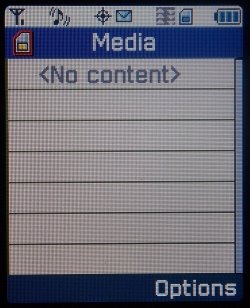 Dang, the songs aren't in here either.
So I went back to the Music icon, which holds the music store (powered by Groove Mobile). It has a tab labeled Player. When I open that, I finally find the songs. What's more, I discover that I can sort them into playlists. That looks good. I create a new playlist and save it, then exit the music store.
Then I go back to the Media Player icon, and look for the new playlist. Nope, still nothing there.
I decide to try something else. One nice thing about this phone is that when you close the flip cover, there's a small display and music controls on the outside so you can use the phone like an iPod. I try them. But it turns out they don't connect to the music store either. I can't see my playlist, and I can't play any of the songs I paid for
So I have to go back into the music store. While there I notice two other challenges:
--The music store disables the phone. You can't dial out while it's running, and all of your incoming calls are routed direct to voice mail.
--The music store and its cache of songs are all one thin client app. So if you don't have coverage you can't get to your music. That means no listening to your tunes while you're in an airplane.
So here's how it apparently nets out, folks: If you rip or steal MP3s and download them from your computer to the phone, they end up in the phone's built-in media player. You can receive calls while listening to these songs (the phone pauses them automatically), and you can turn off the radio and still use the phone as a music player. But if you buy the songs legitimately from Sprint's online store, the media player can't see them, you can't play them when the radio's off, and you can't receive calls when you're listening to music.
Having worked in the mobile industry, I know how this sort of thing happens – Samsung designed the phone separately from Sprint's service, and there wasn't enough time or money to integrate the phone and service properly. But what a nasty thing to do to the user.
Sirius: Streaming music (with limitations). The Media Player also gives me access to Sirius radio, which I thought was fairly interesting. The client is built into the phone, and costs $6.95 a month. Unlike the video downloads, I got full channels. Good. I'm not sure how pleased a Sirius fan would be, though – there are only 20 channels, all of them music (no sports, no comedy, no Martha Stewart, no Howard Stern). So for a little over half the price of a full Sirius subscription, you get 1/8 the channels. Not a superb value.
Still, I found a channel I liked and the sound quality was okay and I was feeling fairly good about things. I decided to leave the music on in the background while I tried other features.
Oops.
I have to exit the Media Player to do anything else. The music stops. Same thing if I want to dial the phone – I have to explicitly quit the Media Player first. In fact, if I try to dial a number while Sirius is playing, the phone thinks I'm trying to pick a different radio channel.
As was the case for downloaded music, it appears that you can't receive calls when you're running the Sirius client. The main reason for owning a mobile phone is to make and receive calls; this app is equivalent to a car whose radio doesn't work unless you park.
I'm not sure how often most people would want to use this service.
(After some searching online, I think I've found out why incoming calls are blocked. Apparently the phone is set up to block incoming calls anytime there is an EVDO data session. This is supposedly a compatibility feature because Sprint's older, slower 1XRTT data network can't interrupt a data session. So the built-in media player can play MP3s and still accept calls because it doesn't talk to the network, but Sirius and the music store can't accept calls because they initiate an EVDO session. There are online reports that you can use a secret code to enable incoming calls on the phone during an EVDO session. Sprint doesn't encourage this and says it may disable some future services, such as push e-mail.)
Games do work. To be fair, I should mention that games seemed to work properly on this phone. I lent it to my 11-year-old son, and he downloaded games at a furious pace. Filled up about half of the memory card. Regular old telephony seems to work fine as well.
The interface
Inconsistent navigation. When a phone has a lot of functions embedded behind icons, it's important the user easily undo commands and get back to where they were in the interface. This encourages the user to explore and try new functions. If it's easy to get lost in the interface, the user will become very reluctant to try things – which translates to less usage of those lucrative data functions that the operators want to sell.
This phone has three different ways to go back – there's a Back button, an End button, and sometimes one of the soft buttons is designated as an undo button. It's never clear which one will work in a particular situation, and sometimes I had to use them in different combinations. In some sub-menus within functions, there was no way back at all – my only option was to use End to go all the way back to the start of the interface.
For example, when I tried the New York Times player, I was not impressed with the newspaper content. So I hit the Back button. Only that didn't do anything. So I tried the soft button labeled Quit, but all that did was take me back to the splash screen for the NYTimes app. This is confusing, since I thought that splash screen was part of the NY Times app. If I were a normal user I would be totally lost at this point, but eventually I realized that Quit exited the Java runtime and dumped me back on the splash screen from which Java had been launched.
This must have made sense to someone at Sprint, but it won't to most users.
Anyway, from that point the back button works. I try to back out all the way to the main menu, but the program dumps me into a Downloads screen and refuses to go back any further. I have no idea why I'm in Downloads, but I press End to get away from that before I accidentally buy something.
I think this sort of screwiness happens in part because the phone has applications produced by various third parties, each of which does its navigation differently. But that's no excuse – Sprint should provide interface guidelines, and enforce them on its developers. By failing to do that, Sprint is neglecting its job as the integrator of the device.
Graphical toejam. Each of the twelve icons in the main services menu animates when it's selected (this is called a "focus effect"). I can customize the animation – in one effect, the icon grows larger and changes shape. In another, it's backed by flames. In another it's superimposed over a blob of purple Jell-O. In another it's backed by rippling water effects. All of this is cute, but it's mostly a sign that the people working on the phone had no idea how to allocate their time. They made visual fluff while major parts of the phone didn't actually work.
The synesthesia user interface. Sometimes the people designing a multimedia device feel the need to add a lot of sounds and graphics to it just to prove that it has multimedia capabilities. This is the technology equivalent of a 15-year-old girl who wears halter tops, lowrider jeans and heavy makeup just to prove she's developing curves – and it's about as attractive.
(In other words, a 15-year-old would think it's hot, but I think it's alarming.)
In this phone, the teenage tart routine shows up in the dialer. Instead of making the standard tone noises when you press a key on the keypad, this phone generates offbeat plink and bing sounds, and every number you dial shows up on screen in a different color. It reminds me of the articles I've read about synesthesia, a sensory condition which causes some people to mix their senses – they can hear colors or see sounds. One of the phenomena they sometimes report is that letters and numbers each have their own distinct colors.

Sprint's phone helpfully lets you experience this condition for yourself:
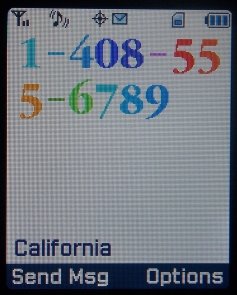
Lookie! It doesn't know enough to insert a line break after the hyphen, but it assigns a cool color to every number.
I count myself lucky that the phone can't generate smells, or the caller ID might work by odor.
"Woah, dude, did you step in something??"
"Nah, my boss just left me a voicemail."
(By the way, it turns out there's an obscure menu command that turns off the rainbow numbers. But I had to study the user manual to find it. How many users are going to do that?)
What it all means
I have very fond memories of Sprint. They were one of the first operators to support Palm OS, and I had a great working relationship with several of the people there. I wish them well. But I think they're on the wrong path with mobile data.
Sprint's going to get a distorted view of public demand for data services. Because the games are relatively easy to find and use, they're going to get more usage. Many other data services won't be used because they're hard to find, hard to figure out, and often deeply disappointing.
If a handheld vendor produced a product this broken the company would go bankrupt. But of course that's not going to happen to Sprint because the mobile data thing is a sideline to its successful voice business. All that will happen to Sprint is that it will waste gobs of R&D money and frustrate its customers.
I think it's arrogant for a mobile phone company to try to make decisions for its customers on what they should or should not do with data. The voice equivalent would be if they tried to regulate what subjects could be discussed on a voice call. Who would tolerate that?
I strongly encourage the folks at Sprint to ask themselves if they're truly competent to create wireless data services. The strong evidence is that they're not. I think they would have a much better chance of making money if they opened up the data network to all third party developers and let customers choose which services will win. Maybe Sprint could make money by taking a cut of the billings, just as DoCoMo does with iMode. Or maybe it could just focus on being a carrier for other peoples' data, which is what it does with voice. Either choice would be better than creating more media hairballs like this phone.
_______________
PS: Is the Sprint Ambassador program a good idea?
I'm a big fan of "influencer marketing," the process of working with early adopter customers who advise others on whether or not to buy a product. It's a very affordable way for companies to work with vertical markets without making a huge investment in each, and it allows even small companies to have a big marketing impact if they make a great product. It's also an outstanding way to get feedback from your most enthusiastic customers.
The Internet made influencer marketing possible for most firms. Because it's a new field, the ground rules for it are still being worked out. My colleague Nilofer Merchant recently wrote about an influencer marketing program that Lego runs, and Microsoft has been running a program called MVP for years.
Most influencer marketing programs focus on building two-way relationships with a relatively small number of users. The Sprint program is different in that it appears to be recruiting a relatively large number of people, and the approach is not very personal – they just send you an e-mail (and one that isn't signed by any identifiable person). There's a whole sub-thread of discussion in the blogging community on whether the Ambassadors program is a good thing. Sprint has made almost no effort to engage in a dialog with me, other than an occasional automatic-looking e-mail asking me to send in feedback. They basically just threw a free phone at me.
One school of marketing thought says that any form of publicity is a good thing (although some former Firestone Tire executives might beg to differ). A Google search for the term "Sprint ambassador" yields about 23,000 hits, so the program is generating some buzz. But a random walk through the comments shows more discussion about the program than actual discussion of the phone and service. Some of the comments complained about the impersonality of Sprint's approach, and there were a number of complaints from Ambassadors who wanted to transfer their current phone numbers to the Ambassador phone (something Sprint says it can't do for billing reasons). This hamstrings the program for many people because it means they can't make the Ambassador phone their main phone. It's more like something to play with on the side, which is the way I use it.
There's also an amusing post from a blogger in Copenhagen, who was invited to join the program even though the nearest EVDO cell tower is about 4,000 miles to the west.
So is the Sprint Ambassador program good marketing or bad marketing? Hard to say because I don't know what Sprint's goal was. It's not a home run, that's for sure, because so much of the online discussion is about the program itself rather than the phones.
On the other hand, maybe Sprint should be grateful for that since the phone and services have so many problems.
_____________
What do you think? Am I being unfair to Sprint? Do you have this phone and like it? You're welcome to post your thoughts.
Several days ago a financial analyst in Canada floated the idea that Apple and RIM might collaborate to create the merger of an iPod and a Blackberry. Most of the online skepticism about this idea has focused on the incompatibility between the RIM and Apple cultures, particularly their large-ego CEOs, but there's a much more serious reason why it's a dumb idea:
iPods are beloved by young people and creative types who want entertainment on the go. Blackberries are beloved by fast-moving corporate managers who want to squeeze a little more productivity out of their busy day.
Young and mature. Carefree and career-driven. Slacker and buttoned-down. What's the intersection between those two groups?
Right: Virtually nonexistent.
So, how many people would buy the Frankenpodberry?
Every 20-something surfer-dude IT manager on the continent. Plus some technophiles. But not a mass market.
Convergence works only when you combine two features that are both desired by the same demographic group. Making a mobile device ain't like making a Reese's Peanut Butter Cup, folks.
Does this mean Apple and RIM would never partner? Not at all, lots of companies do dumb things. But I think the product wouldn't sell.
Over at the business book I'm writing, Stop Flying Blind, I've finished with competitive analysis and am starting to discuss how to understand and use market research. If you're interested in the topic, you're welcome to stop by.
Last month I went to a talk at the Computer History Museum by Ward Cunningham, the father of the wiki (not of Wikipedia, but of the general idea of a wiki).
Wikis are a pretty controversial subject in the blogging community. Some people view them as one of the crowning glories of Web 2.0 software design. Others view them as a prime example of the moral bankruptcy of the whole Web 2.0 crowd. Generally Wikipedia is used as the example to prove either viewpoint.
I'm somewhere in the middle – I view the wiki as a tool, something that's neither good nor bad in and of itself. To me, the most interesting thing about the wiki concept is what it says about software engineers.
Cunningham described his thinking as he developed the wiki concept. He was looking to encode in software the sort of discussions that engineers have among themselves. If you're not an engineer, this will require a little bit of explanation. Engineering is closely allied with science, and shares many of its values. There's a strong belief in the existence of objective truth, something that everyone can agree on if presented with the right evidence. Vigorous debate is deeply respected as a way to discover the truth, a kind of Darwinian process in which the best ideas are the ones that survive. And everyone who participates in a debate is assumed to have the same energy level and commitment to seeking the truth. (I suspect this alignment with the values of scientists is one reason why Nature magazine came out in support of Wikipedia.)
A wiki is designed to facilitate the sort of debates that engineers have among themselves. When it works right, it can dramatically increase the speed with which a group reaches agreement, and can quickly integrate the ideas of many contributors.
A challenge for wikis is that many (actually, most) people don't share the engineering culture. Many people are deeply attached to their beliefs and aren't willing to revisit them no matter how much evidence is presented. In many subjects one person's idea of objective truth may be very different from another's, and in some (religion, for example), it's arguable whether there can be any truly objective truth at all. Energy levels and willingness to participate in an extended discussion also differ dramatically from person to person. Often the most energized people are the fanatics, the people who are least likely to engage in an unbiased debate.
All of these mismatches between wiki ideals and human behavior can cause a wiki to misfire.
So is that a fatal flaw in the wiki concept? I don't think so. Every human institution that I can think of encodes the values and assumptions of the people who created it. Laws are generally created by lawyers (at least in the US), who have a very strong culture based on adversarial balances of power. They tend to focus on creating idealized processes with strong checks and balances in them. Economists have their own view of human nature, based on the assumption that people are self-interested and driven by risks and rewards. They tend to focus on creating systems of incentives and punishments that will encourage the desired behavior. Religious leaders focus on faith and ethics, seeking to adjust what people think and want.
All of these systems have strengths to the extent that they embody truths about human beings, and weaknesses because no single set of ideas can explain all of human behavior. None of them are perfect, but I think we're stronger when we have several different ways of looking at the world. So I'm glad that the engineers are joining the lawyers and economists and priests in designing human institutions. It gives us another set of tools in the tool belt. Rather than arguing about whether wikis are intrinsically good or bad, I think we should be asking when that particular tool is most useful, and what safety precautions we should use with it.
(A side note: it turns out that Cunningham pronounces wiki as "weekee," not "wicky." Who knew?)
______________
By the way, I'm sorry I've been slow to post lately. I've been working with my neighbors on a dispute with a property developer, and that used up most of my blog-writing time in the last two weeks. We're now past our big city hearing, and I should be able to get back to posting at least once a week.


